

Jisu Samuel Kim
PHD STUDENT
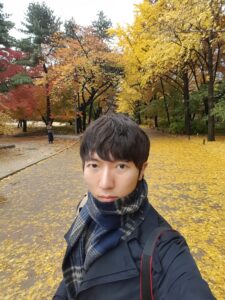
| Contact Information | |
| E-mail: | jisu.kim@cea.fr |
| Office: | Bâtiment 709, Pièce 281 |
| Affiliation: | DRF/IRFU/DAP - UMR AIM |
| Supervisors: | Sandrine Codis, Jean-Luc Starck |
About me
I am a 1st year PhD student under the supervision of Dr Sandrine Codis and Dr Jean-Luc Starck.
Research Interests
I am interested in understanding why and how the matter distribution is organised into the large-scale structure, what kinds of statistical correlations and properties exist within this structure, and which fundamental physical laws govern the whole Universe from the past to the future.
Motivated by these questions, during my undergraduate studies I reviewed Genus statistics. In this work, I summarised the mathematical and physical background required to understand Genus statistics. I also analytically derived the equation under the assumption of a Gaussian random field and reviewed its applications in cosmology. Through this project, I developed a solid theoretical foundation for interpreting the matter distribution from a statistical and topological point of view.
During my master’s project, I extended this theoretical interest towards a more computational approach using simulation data. Specifically, I measured the weak lensing signals related to filamentary structures. I employed the Minimum Spanning Tree method and demonstrated that MST is an effective tool for measuring these signals. This work allowed me to gain experience in connecting the geometrical properties of large-scale structure with weak lensing data.
I have recently started my PhD, where my main research goal is to constrain cosmological parameters using summary statistics based on wavelet transformations. As a first step, I plan to establish the theoretical background of wavelet transformations and to study how the probability distribution function of wavelet-transformed convergence maps responds to changes in cosmological parameters. I then aim to apply Euclid data set for cosmological inference. While my current focus is on wavelet transformations, I would like to broaden my research interests in the long term to include other summary statistics, weak-lensing-based mass mapping, and potential applications of symbolic regression. In this context, I am currently involved in weak lensing research at CosmoStat, and I have recently begun participating as a member of the Euclid Consortium.
Beyond my academic research, I have a strong interest in the public communication of science, the sustainable use of outer space, and the social responsibility of an astrophysicist. As I pursue my PhD, I feel a strong responsibility that comes with this opportunity. If given the chance, I would be very keen to share the higher education and research experience I have received with the wider public, especially with those who have limited access to educational opportunities. As an astrophysicist, I also believe it is important to promote the sustainable use of the night sky and the space environment. Hence, I have been involved in related institutes and organisations even before starting my PhD.
Education
- Master's degree in Astrophysics, University College London, UK, 2024
Thesis: Maximising filament lensing signals with the Minimum Spanning Tree
Supervisor: Prof Benjamin Joachimi, Dr Krishna Naidoo
Keywords: Minimum Spanning Tree, weak lensing measurement, ray-tracing simulation, Python data processing
- Bachelor's degree in Astronomy and Space Science, Kyung Hee University, Republic of Korea, 2019
Thesis: The concepts and uses of Genus Statistics in galaxy formation, evolution and modern cosmology
Supervisor: Prof Yunyoung Choi
Keywords: Genus statistics, analytic derivation, theoretical approach